The Lobby
20 years out I pose the always-question: were/are Mearsheimer and Walt bravely-bold truthers, timidly-cooperative Jewphobes, or both?

While browsing YouTube last week I came across a recent episode of the Jew-sucker Chris Hedges' pod with John Mearsheimer as the guest, and was kind of shocked to see it had over one million views. Then later I was listening to a cut of Hasan Piker’s twitching built on top of that interview, where he was pleasantly surprised to see that many views for the video, and Hasan referred to Mearsheimer and Hedges as two of his GOATs. While I certainly understand why Hasan would say that, based on his Jewcentric leftist politics and his strong criticism of Israel and its relationship with the US, at least in the case of Hedges I am not really in agreement with him. I mean, while I am in agreement with a lot of what Hedges says and think it's good that he says it, I also think he’s a strident supporter of the primary causal agents of so many of the problems that he addresses. His recent need to stick a knife into one of his most long-standing loves, Gnome Chomsky, speaks to that fundamental inadequacy within his public persona.
But it’s Mearsheimer who I will tackle here today, and because he also made an appearance on Grayzone’s latest livestream, and at the beginning of that he said the original article that he and Steve Walt wrote on the Lobby was published 20 years ago this week, the year before the book they wrote on the same subject was published. I have never read that book, and I realized that I have never read the article either, and so I’ve found it and given it a read, and that and the GZ discussion are the subject of this piece, a kind of anniversary celebration of a stake in the ground of resistance to the multi-decade slow advancement of Jewish power and control within the US governing structure, formal and informal, public state and deep state.
First we must understand what the Lobby is, as that single term is wholly inadequate in defining what it actually is, and of course people can define it in many different ways. But I do not think I have ever heard Mearsh actually define what he considers it to be, an oddity given how many times I have heard him refer to it, which may well be in four figures at this point. While international relations realism defines Mearsh academically and philosophically, “the Lobby” defines him as a public figure.
So I will jump into the GZ discussion where Max Blumenthal has asked him to define it, about ten minutes into the discussion:
The first thing to note is that Mearsheimer isn‘t limiting the Lobby to organizations whose primary purpose is to lobby politicians in DC on public policy, and the first indicator is that he is including individuals and then names Alan Dershowitz as a example, someone who I would have never characterized, professionally or otherwise, as a lobbyist.
But then he goes right to what the Lobby isn’t, which is Jewish. This is very important to understand he says, but he does not say or even hint at why this is very important to understand. Instead he goes to significant numbers of Jews who opposed what the lobby does, which of course is once again the “not all Jews” illogical argument.
Then he goes anecdotal by saying almost all of his and Walt’s defenders back then were Jews and that the goys kept their heads down, stayed out of that fight. That in itself suggests that the matter is a Jewish matter and not the opposite. It also speaks to the power and bias of the Lobby, which was perceived as capable of destroying goys who opposed it but would treat Jews who opposed it somewhat less harshly. Not kindly, but less harshly.
So it’s not a Jewish lobby, even though there are an enormous number of Jews who make up the Lobby as he defines it. And of course this also leads him to Christian evangelical Zionists, who are seemingly the only non-Jewish component of the lobby that anyone can ever name.
Next he describes how powerful the lobby actually is, simply unparalleled in its influence. Which is why it’s so important to understand that it’s not Jewish, methinks, because if it was Jewish then the the Jews would be running the country, at least related to middle eastern policy, and that would be an antisemitic trope. 🫣 That in some sense so defined by… you guessed it - the Lobby itself, which we have to remember is not Jewish. A vicious circle.
As in this discussion, the article doesn't define what it is talking about until well into it, on page 14 of 41 text pages of the PDF version I am working from. At that point they had already gone over the myriad of problems within the case for support of Israel as US policy, which is some of the more hard-hitting material in the piece. Here is what it then says:
We use “the Lobbyʺ as a convenient short‐hand term for the loose coalition of individuals and organizations who actively work to shape U.S. foreign policy in a pro‐Israel direction. Our use of this term is not meant to suggest that ʺthe Lobbyʺ is a unified movement with a central leadership, or that individuals within it do not disagree on certain issues
The core of the Lobby is comprised of American Jews who make a significant effort in their daily lives to bend U.S. foreign policy so that it advances Israel’s interests. Their activities go beyond merely voting for candidates who are pro‐Israel to include letter‐writing, financial contributions, and supporting pro‐Israel organizations. But not all Jewish‐Americans are part of the Lobby, because Israel is not a salient issue for many of them. In a 2004 survey, for example, roughly 36 percent of Jewish‐Americans said they were either “not very” or “not at all” emotionally attached to Israel.
Jewish‐Americans also differ on specific Israeli policies. Many of the key organizations in the Lobby, like AIPAC and the Conference of Presidents of Major Jewish Organizations (CPMJO), are run by hardliners who generally supported the expansionist policies of Israel’s Likud Party, including its hostility to the Oslo Peace Process. The bulk of U.S. Jewry, on the other hand, is more favorably disposed to making concessions to the Palestinians, and a few groups—such as Jewish Voice for Peace—strongly advocate such steps. Despite these differences, moderates and hardliners both support steadfast U.S. support for Israel.
So again it’s organizations and individuals with a particular interest in Israel as the beneficiary of US foreign policy. But the core of that is made up of Jews, American Jews, so at its core it is Jewish, and goys (Christian evangelicals) are apparently only a peripheral part of it. Perhaps that’s a little like saying a Christmas tree is not a tree because you’ve hung some bright, shiny ornaments on it?
Again they go to “not all Jews” here, for reasons unclear. They cite polling that suggests roughly a third of American Jews aren’t that “emotionally” attached to Israel. But as I have cited, polling suggests that over 90% of Jews supported Israel, if not unconditionally, which suggests M&W were specifically looking for polling which served the purposes of downplaying the level of Jewish support and beefing up “not all Jews”.
The “unconditionally” part of that comes next - I believe that a majority of American Jews did not (I am speaking of pre-10/7) fully support Israel policy when it comes to the Palestinians. And they echo that here, adding the ubiquitous JV4P. But then they confirm that both moderates and hardliners push US support for Israel, which gets us back to my 90%+.
More:
Jewish‐Americans have formed an impressive array of organizations to influence American foreign policy, of which AIPAC is the most powerful and well‐known. In 1997, Fortune magazine asked members of Congress and their staffs to list the most powerful lobbies in Washington. AIPAC was ranked second behind the American Association of Retired People (AARP), but ahead of heavyweight lobbies like the AFL‐CIO and the National Rifle Association. A National Journal study in March 2005 reached a similar conclusion, placing AIPAC in second place (tied with AARP) in the Washington’s “muscle rankings.”
The Lobby also includes prominent Christian evangelicals like Gary Bauer, Jerry Falwell, Ralph Reed, and Pat Robertson, as well as Dick Armey and Tom DeLay, former majority leaders in the House of Representatives. They believe Israel’s rebirth is part of Biblical prophecy, support its expansionist agenda, and think pressuring Israel is contrary to God’s will. In addition, the Lobby’s membership includes neoconservative gentiles such as John Bolton, the late Wall Street Journal editor Robert Bartley, former Secretary of Education William Bennett, former U.N. Ambassador Jeanne Kirkpatrick, and columnist George Will.
There we have shifted to AIPAC alone and not the entire lobby, as Mearsh would define it or as I and many others would define it, which is more narrowly. Their rivals are the NRA and AARP, which are the core of much more consolidated lobbies - can you name number two for either of these advocacy groups? I can’t.
Then it’s back to the evangelicals, and here they expand their definition of the Lobby even further to include actual sitting members of Congress, something that is at minimum a questionable thing to do. Then more goys who fall outside of Christian Zionism, which gets us to what we can call the goy neocons, which I will get to.
But first, I’ll turn to an alternative critical view of the Lobby, this from Jeff Gates, former counsel to the Senate Finance Committee, on Red Ice back in 2015 discussing his 2008 book Guilt by Association:
There Gates highlights the importance of the CoP (or CPMJO in the Lobby article as quoted above), because of money and campaign contributions. But it should be noted that since then AIPAC created and began using its own SuperPAC starting in the 2022 election, in addition to its network of bundlers, so that is no longer true to the same extent.
M&W also mentioned the CoP above, so they also recognize its importance. What isn’t mentioned is the significance of its name, which refers to the major Jewish organizations and not pro-Israel organizations. But remember, it's not the Jewish lobby. 🙄
Gates was overly optimistic there about FARA registration, it’s as far away today as it was a decade ago, even though Bibi has finally succeeded in selling the (current clown-led) US administration on an unpopular war with Iran.
One of the important things to note here is that the Lobby as Mearsh defines it isn’t really something that can be required to register under FARA - can Alan Dershowitz as an individual be required to register as a foreign agent because he works personally to enhance the US-Israel relationship? How about John Hagee or Lindsey Graham?
In there Gates tells the story of JFK in 1960, and here is where I went into that business and the first 15 years of the “Israel Lobby” in more detail, if you’re interested:
Back to the Mearsh interview and Max’s other question, on the evolution of the Lobby and US policy, now that “we” are at war with Iran:
This is where how one defines the Lobby becomes even more important. My view is that what they are calling the Lobby is actually more equivalent to what I call the Jewish-Zionist faction of the deep state. And in fact it's broader than that in some respects because he’s including elected politicians, who are technically part of the public state.
Ask yourself if this sounds like a mere lobby when he describes it going after him and Walt for publishing this paper. That surely underlines why they were/are so insistent that it’s not Jewish, because in fact they are talking about something that isn’t just a lobby which pushes support for the Jewish state, they are talking about a larger operation which has intentions and goals that go beyond Israel.
And in today’s terms we do have that Mearsh iceberg with a tip, that increasingly-large tip made up of Gaza, Epstein and Iran.
Where Max takes this is to the Lobby actually being the Zionist movement. There he cites three notable government-enabled “Zionists”, Kushner, Witkoff and Blinken, of course all Jews. He’s right with respect that the Lobby isn’t the same thing as the NRA or AARP, that’s undeniable.
Mearsh is fine with calling it the Zionist lobby instead of the Israel lobby, which suggests that he isn’t comfortable equating his Lobby with the entire Zionist movement. He then tells a story about Aaron David Miller and Dennis Ross at Camp David in 2000; he says, “these were Americans who were working for Clinton”. Miller is a Jew and Ross had a Jewish mother and a Catholic step-father, which means he’s ethnically Jewish. This is how it was included in the article: Indeed, one American participant at Camp David (2000) later said, “far too often, we functioned . . . as Israel’s lawyer.”
But he’s right, there’s no difference between these two and Witkoff and Kushner, they’re all Jews. And that story doesn’t really explain what Mearsh sees as his defining of this blob as the Israel lobby while Max defines it as the Zionist movement. The real difference is what these two see as the problem - Mearsh sees Israel as the problem and Max sees Zionism as the problem, so one is about a foreign nation (which goes undefined as an ethnostate) and the other is about a (seemingly ethnicity-free) political movement. In some sense it’s the difference between Germany and Nazism 85-90 years ago.
A bit later Max gets to the emerging bulk of that iceberg, and an essential pet animal:
So here we have the tail-wagging dog question, and John and Max are on the same page. But apparently Stormin’ Norman wasn’t, 20 years ago he had the doggy wagging it’s own tail, poor little Israel the victim of the evil goy US’s imperialism. And where did he get that? If I have to guess it was “according to Chomsky”, a bad habit that the Fink readily admits to - that’s Gnome’s line, that Israel has always been an American puppet state. We should also remember that that would have been years after Norm’s work on the Holocaust Industry was published, so the idea that Israel’s manipulative ethno-allies in the US using that mythology for the benefit of Israel isn’t quite his story.
Me, I have never been that much of a fan of Finkelstein, who I think is as much a part of the problem as part of the solution. And that mainly because he is such a raging Holocaustist, the mythology that underlies all of this, that having perhaps been best displayed in his notorious “crocodile tears” moment, angrily playing that trump card to battle the tears of a girl with German ancestry who felt the guilt laid all over her and hers.
Mearsh’s logic is that if Israel was a puppet of the US you would not need the Lobby, which does make some sense. But again that is entirely dependent on his definition of what the Lobby is and what it’s goals are, and remember how broadly-defined his Lobby is.
As I said earlier, I think Gates defines it more narrowly, really the 80 or so organizations which make up what used to be called the Jewish lobby or the Jewish-Israel lobby, they including organizations like the American Jewish Committee and the ADL, which predate Israel by decades. But in that Red Ice discussion he does go into what is more aligned with Mearsh’s definition:
There is so much in that ten minutes or so (at normal speed). I’ll start with his five domains of power: news media, pop media (mainly Hollywood), government (largely through campaign financing), think tanks (again largely by funding them) and education. On the latter he focuses on higher education, but we should also include Holocaust training at an earlier stage, maybe even in kindergarten at this point.
On higher education, his example is neoliberalism, Chicago School economics, which never gets as much attention as it rightly deserves. Unlike neoconservatism, which is where the Israel issue resides, but just like Cultural Marxism, it has deeply embedded itself into how Americans view the world and their daily participation in that, the worship of money and the righteousness of the battle over that. Even Bernie’s “free stuff” schemes that were the heart of his campaigns are rooted in the neoliberal mentality. And of course they have brought us our oligarchy, which Gates correctly predicted in that book back in 2008, months before the big neoliberal disaster resulting in the Great Recession.
In the Mearsh&Walt article there are consecutive section titles as follows:
Influencing Congress
Influencing the Executive
Manipulating the Media
Think Tanks That Think One Way
Policing Academia
So this is basically the same thing, it’s just cut in slightly different ways. The section that follows these is titled The Great Silencer, and it starts with this: No discussion of how the Lobby operates would be complete without examining one of its most powerful weapons: the charge of anti‐Semitism.
But I won’t go into that further here - the Lobby isn’t the Jewish lobby, oh no.
I started that clip where I did because there are a few important matters included there. One is how right-wing Israel’s politics are, which does create a sort of separation with American Jewish politics that is important to remember. When he talks about demographics and Russian immigrants, that was a consequence of the west’s victory in the cold war and then the neoliberal assault on Russia in the 1990s, driving many remaining Russian Jews out and into Israel but also into the US. He mentions Rabin’s assassination by the right, and here is how the article handled Rabin’s politics: Prime Minister Golda Meir famously remarked that “there was no such thing as a Palestinian,” and even Prime Minister Yitzhak Rabin, who signed the 1993 Oslo Accords, nonetheless opposed creating a full‐fledged Palestinian state.
So let’s delve deeper into the article. In the section where they describe the Lobby they include this:
The Israel Lobby’s power flows from its unmatched ability to play this game of interest group politics. In its basic operations, it is no different from interest groups like the Farm Lobby, steel and textile workers, and other ethnic lobbies. What sets the Israel Lobby apart is its extraordinary effectiveness. But there is nothing improper about American Jews and their Christian allies attempting to sway U.S. policy towards Israel. The Lobby’s activities are not the sort of conspiracy depicted in anti‐Semitic tracts like the Protocols of the Elders of Zion. For the most part, the individuals and groups that comprise the Lobby are doing what other special interest groups do, just much better. Moreover, pro‐Arab interest groups are weak to non‐existent, which makes the Lobby’s task even easier.
So it’s basically no different than other ethnic lobbies, the difference is that it’s just more effective. But it’s that next statement in bold that you should ruminate upon. On the one hand, it’s not illegal for Americans to make their opinion heard on how they want our government to deal with some foreign nation, that’s part of a democratic open society. On the other hand, there’s nothing improper about what the Lobby does?For instance, attempting to destroy people’s careers and lives by making unfounded accusations of antisemitism? Or doing everything they can to override the spirit of democracy and replace it with minority rule, Ashkenocracy, at least informally?
By making the statement they did on the Protocols, what they are saying is if you accuse the lobby of doing uniquely horrible or despicable things, you are being antisemitic. No, all you can do is accuse them of doing the same things as other lobbies, and just doing it better. I also think it’s worth noting that they refer to what is generally viewed as a faked document, the Protocols, instead of something undeniably real from the same era, the Vatican’s Civilta Cattolica series of articles on The Jewish Question in Europe. Strawman much, John?
One other important thing to note is that the comparison they make is to the Arab ethnic lobby, which is a clear statement of the universe of their activism, that of course being Israel as the Israel lobby. But is that the ethnic group that is getting run over by the Lobby as Mearsh & Walt define it? I would argue not, I would argue their opponents in their activities are two others: the American goyim, and the American Euro-Christian ethnicity. The latter ethnicity has no lobby at all, because as the hated majority they are not allowed to band together in any formal way, that was the primary goal and is the outcome of cultural Marxism.
Anyone who thinks this is a cage match between the lobbies for Israelis and Arabs is a fool. At least M&W aren’t saying this is a cage match between Jews and Muslims, they’re not playing the Judaism/Zionism conflation game. At least not yet…
In the section titled Influencing Congress this is included, where it is talking about the Lobby going after congressmen who do not tow its line:
One could also include Senator Hillary Clinton (D-NY), whose support for Palestinian statehood and public embrace of Suha Yarafat (wife of PLO Chairman Yasser Arafat) provoked strong criticism from groups in the lobby. Not surprisingly, Clinton became an ardent defender of Israel once she began running for office herself.
[I’ll note here that there are differing versions of this article online and the one I have been working from as my quote source does not have this in it.]
What this reminded me of is a part of dualie donor Haim Saban’s wiki which addresses Nancy Pelosi:
In March 2008, Saban was among a group of major Jewish donors to sign a letter to Democratic Party house leader Nancy Pelosi advising her not to interfere in the Democratic presidential primaries. The donors were upset by Pelosi’s statement that the party “superdelegates” should heed the will of the majority in selecting a candidate. The donors, who were strong supporters of the DCCC, implied that Pelosi could lose their financial support in upcoming congressional elections. In May 2008, it was reported that Haim Saban had offered $1 million to the Young Democrats of America and urged the endorsement of Hillary Clinton as the Democratic nominee for president.
We can see here how these two roundly-hated examples of Dem centrism started out more reasonable in their views until the Lobby sunk their teeth into them.
Another of the sections that I mentioned above, on influencing the executive, starts with this:
The Lobby also has significant leverage over the Executive branch. That power derives in part from the influence Jewish voters have on presidential elections. Despite their small numbers in the population (less than 3 percent), they make large campaign donations to candidates from both parties. The Washington Post once estimated that Democratic presidential candidates “depend on Jewish supporters to supply as much as 60 percent of the money.” Furthermore, Jewish voters have high turn‐out rates and are concentrated in key states like California, Florida, Illinois, New York, and Pennsylvania. Because they matter in close elections, Presidential candidates go to great lengths not to antagonize Jewish voters.
That level of contributions is something that rarely if ever gets quantified. But it is consistent with other numbers I have seen, including in this study published in Israel in 2016:
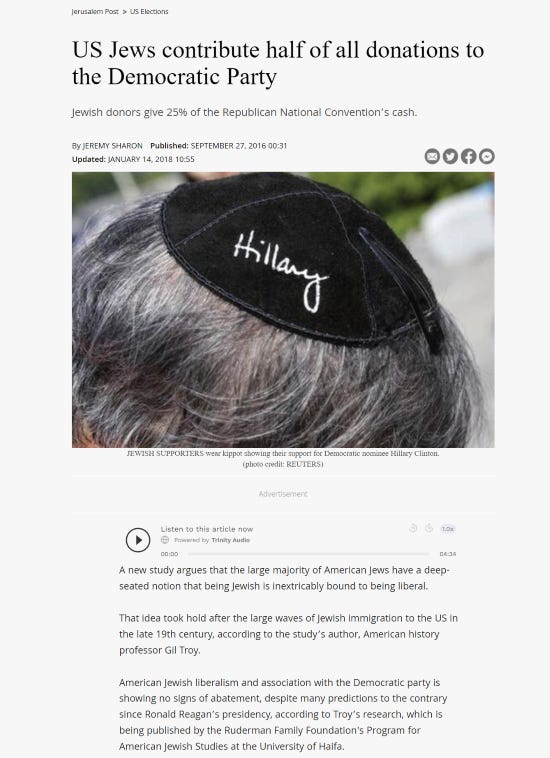
The story in that piece isn’t about overwhelming Jewish campaign contributions overall, it’s about how they are predominately made to the Dem left, Jews “only” contributing a quarter of the money going to the GOP, maybe 20 times a proportional amount to their numbers in that party. That kind of suggests the average Israeli would not at all be surprised that American Jews have bought off the American government.
But that is a staggering number, maybe 3-4% of Democrats contributing 50-60% of the money and 1% give or take of Republicans making 25% of those contributions, the lifeblood of politics. Why don't I hear anyone really talking about that? What you hear is Miriam Adelson and what you used to hear was George Soros, rather anecdotal stuff and not the meat of the matter, which is mountains of shekels. Jews own the party and nobody will say it. I was very surprised to see this said here, because I have never heard Mearsh actually say it.
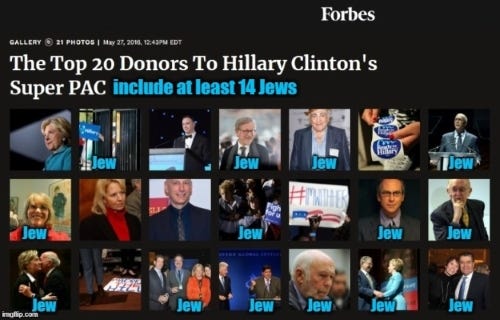
I should mention that the congressional section says nothing about Jewish campaign contributions, and that Israeli study includes congressional campaigns, unlike the M&W statement.
I’ll also mention that Mearsh never addresses the matter of money when it comes to Christian Zionists, from Samuel Untermeyer and the creation and publication of the Scofield bible to John Hagee being paid off by his shekel-wielding ethno-donors. Keep peeling the onion and eventually you will uncover the Jew.
At the end of that section of a couple pages the matter of the neocons finally comes up in the last paragraph:
The situation is even more pronounced in the Bush Administration, whose ranks include fervently pro‐Israel individuals like Elliot Abrams, John Bolton, Douglas Feith, I. Lewis (“Scooter”) Libby, Richard Perle, Paul Wolfowitz, and David Wurmser. As we shall see, these officials consistently pushed for policies favored by Israel and backed by organizations in the Lobby.
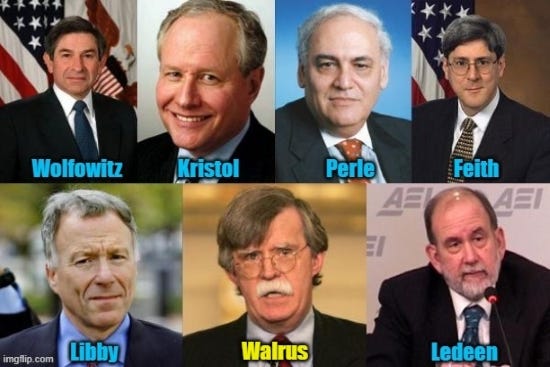
There we see the Walrus included as the one goy in a sea of Jews, the man who enabled the ability to say, “it’s not all Jews!”. Of course he did/does not self-identify as a neocon, but I guess that doesn’t matter - close enough for kosher horse shoes. What would otherwise be Jews are now “fervently pro-Israel individuals”.
Here is where the fomenting of the Iraq war is discussed:
Within the United States, the main driving force behind the Iraq war was a small band of neoconservatives, many with close ties to Israel’s Likud Party. In addition, key leaders of the Lobby’s major organizations lent their voices to the campaign for war. According to the Forward, “As President Bush attempted to sell the . . . war in Iraq, America’s most important Jewish organizations rallied as one to his defense. In statement after statement community leaders stressed the need to rid the world of Saddam Hussein and his weapons of mass destruction.” The editorial goes on to say that “concern for Israel’s safety rightfully factored into the deliberations of the main Jewish groups.”
Although neoconservatives and other Lobby leaders were eager to invade Iraq, the broader American Jewish community was not. In fact, Samuel Freedman reported just after the war started that “a compilation of nationwide opinion polls by the Pew Research Center shows that Jews are less supportive of the Iraq war than the population at large, 52% to 62%.” Thus, it would be wrong to blame the war in Iraq on “Jewish influence.” Rather, the war was due in large part to the Lobby’s influence, especially the neoconservatives within it.
The neoconservatives were already determined to topple Saddam before Bush became President. They caused a stir in early 1998 by publishing two open letters to President Clinton calling for Saddam’s removal from power. The signatories, many of whom had close ties to pro‐Israel groups like JINSA or WINEP, and whose ranks included Elliot Abrams, John Bolton, Douglas Feith, William Kristol, Bernard Lewis, Donald Rumsfeld, Richard Perle and Paul Wolfowitz, had little trouble convincing the Clinton Administration to adopt the general goal of ousting Saddam. But the neoconservatives were unable to sell a war to achieve that objective. Nor were they able to generate much enthusiasm for invading Iraq in the early months of the Bush Administration. As important as the neoconservatives were for making the Iraq war happen, they needed help to achieve their aim.
That help arrived with 9/11. Specifically, the events of that fateful day led Bush and Cheney to reverse course and become strong proponents of a preventive war to topple Saddam. Neoconservatives in the Lobby—most notably Scooter Libby, Paul Wolfowitz, and Princeton historian Bernard Lewis—played especially critical roles in persuading the President and Vice‐President to favor war.
For the neoconservatives, 9/11 was a golden opportunity to make the case for war with Iraq. At a key meeting with Bush at Camp David on September 15, Wolfowitz advocated attacking Iraq before Afghanistan, even though there was no evidence that Saddam was involved in the attacks on the United States and bin Laden was known to be in Afghanistan.
There they outline the importance of the neocons and Jewish organized groups, and there is no mention of evangelical groups. They mention eight neocons by name and six are Jews; the other two are again Bolton and also Rumsfeld, who also didn’t self-identify as a neocon. Sorry, Don, you should have been more careful in deciding on your circle of associates. Then when it got down to it the three most important neocons were three Jews, the ones sitting directly under both Cheney and Rumsfeld, and a British-born historian who was the leading intellectual pushing for the war and met with Cheney (who also didn't self-identify as a neocon) several times to bolster his case.
But they spent a paragraph here making the case for why one cannot blame that war on Jewish influence, which is that polling showed a smaller percentage of Jews than goys supported the war when it started. What they do not address is the split between Republicans and Democrats; here is one indicator of that recently related to the latest neocon debacle:
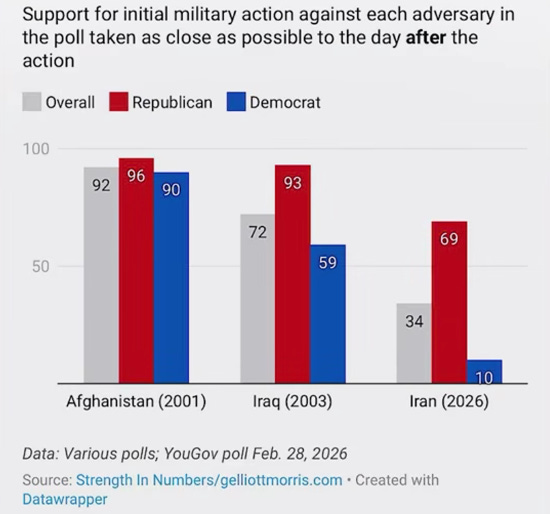
There we see 93% of Repos supporting the war and only 59% of Dems. The overall number is surely much higher in this polling than the one that M&W cited, 62%, so it’s the relativity that one should focus on - Repos 34 percentage points higher than Dems. Two-thirds to three-quarters of Jews and perhaps a bit higher tend to vote Dem - in 2004 Bush got about a quarter of the Jewish vote, which was a notable improvement over 2000, when he got less than a fifth of it.
But the difference between the Jews and the electorate overall is only ten points and nothing like 34, which suggests that the polling cited in the article actually makes the opposite case that M&W were trying to make, or at minimum is neutral. And this is the only case that they make for why Jewish influence wasn’t the cause of the war. Instead they blame the Lobby - which, again, in their definition includes the neocons serving within the administration.
That section went more deeply into Iraq as you would expect, and a handful of neocons, most specifically the Jews Lewis Libby, Douglas Feith and Paul Wolfowitz, formerly baby neocons. Then it discussed Syria and finally the the grand prize, Iran.
The article’s conclusion includes this interesting paragraph, here both versions of it that I find:
But that is not going to happen anytime soon. AIPAC and its allies (including Christian Zionists) have no serious opponents in the lobbying world. They know it has become more difficult to make Israel’s case today, and they are responding by expanding their activities and staffs. Moreover, American politicians remain acutely sensitive to campaign contributions and other forms of political pressure and major media outlets are likely to remain sympathetic to Israel no matter what it does.
and
But that is not going to happen anytime soon. AIPAC and its allies (including Christian Zionists) have no serious opponents in the struggle for influence in Washington. Although a few countervailing forces do exist, they are either significantly weaker (in the case of pro-Arab or pro-Islamic groups) or not interested in broad foreign-policy questions (in the case of oil companies and weapons manufacturers). Organizations in the lobby know it has become more difficult to make Israel’s case today, and they are responding by expanding their activities and staffs. Moreover, American politicians remain acutely sensitive to campaign contributions and other forms of political pressure and major media outlets are likely to remain sympathetic to Israel no matter what it does.
The part in bold is the alteration. What is interesting to me are the parenthetical statements - the first adds as an aside the evangelicals, the second includes the pro-Islamic groups I mentioned earlier as a thankful oversight, and the third names the two industry groups that I have long said were the two main ones, Big Oil and the MIC, within the previous ruling deep state faction, the WASP Rockefellerists.
Finally, the end of the piece:
But there is a ray of hope. Although the Lobby remains a powerful force, the adverse effects of its influence are increasingly difficult to hide. Powerful states can maintain flawed policies for quite some time, but reality cannot be ignored forever. What is needed, therefore, is a candid discussion of the Lobby’s influence and a more open debate about U.S. interests in this vital region. Israel’s well‐being is one of those interests, but not its continued occupation of the West Bank or its broader regional agenda. Open debate will expose the limits of the strategic and moral case for one‐sided U.S. support and could move the United States to a position more consistent with its own national interest, with the interests of the other states in the region, and with Israel’s long‐term interests as well.
Here they take the high road and there is no hint of the domestic ethnic warfare that is at the heart of this matter. The open debate that is needed is a debate about that, the hugely-disproportionate influence that Jews have over our government and what that means specifically in the middle east. Instead we need to debate the surface issues that today are no longer in serious question, the strategic and moral aspects of all this. Yet “the Lobby” churns ever onward.
That came after a paragraph on how US policy pushed by the Lobby isn’t actually in Israel’s best interest, that assumed to be peace with its neighbors as a tiny state based on the pre-1967 borders. But that isn’t what we are talking about when it comes to the Jewish ethnostate, what we are talking about is their desire for a Greater Israel and hegemony over the middle east.
So back to the GZ interview, after Aaron Mate has joined the discussion. Here Max asks the Big Question, stumbling to get it out, and even suggests that requiring just one component of the actual lobby, AIPAC, to register under FARA might have a real impact. What I will ask you to do here is in your mind to substitute “the lobby” with “the Jews” every time you hear the former spoken in this clip:
There Mearsh says it’s all out in the open now, which is very true in one sense, but that exercise I asked you to do shows it’s absolutely not all out in the open in another sense. Here Max adds money to the equation, which Mearsh acknowledges but barely. And here is the other aspect of the invulnerability axis from the article:
A third moral justification is the history of Jewish suffering in the Christian West, especially the tragic episode of the Holocaust. Because Jews were persecuted for centuries and can only be safe in a Jewish homeland, many believe that Israel deserves special treatment from the United States. There is no question that Jews suffered greatly from the despicable legacy of anti‐Semitism, and that Israel’s creation was an appropriate response to a long record of crimes. This history, as noted, provides a strong moral case for supporting Israel’s existence. But the creation of Israel involved additional crimes against a largely innocent third party: the Palestinians.
Of course this must be discussed in the piece, that being a requirement even greater than “not all Jews!” It’s worth noting that Mearsh is specific about the perps in the west here, it’s the Christians, which really means the Catholic Church. And the Jews were purely victims, they were not co-combatants in that centuries-long culture war. It’s also worth noting the qualifier added for the Palestinians - “largely innocent”. So to some extent they were asking for this.
Mearsh says this makes for a strong moral case for Israel, which means a specific nation in a specific place that got created through settler colonialism. But is there any moral case to be made for any form of settler colonialism, a foreign people seizing indigenous-occupied land through forms of violence?
Mearsh goes on to say Megyn and Tucker have crossed the Rubicon and not just gotten into the blue pool up to their ankles. But is that really true? Do either of them actually oppose a Jewish ethnostate? Didn’t Tucker’s hummus-eater bit at the Kirk sainthood celebration confirm his mental roots in the Christian/Catholic bible, the source of all that damned antisemitism?
The reason he mentions these two is absolutely clear - they are Republicans, and the GOP is the heart of the matter on the philosemitism behind the no-daylight Israel position, even as the GOP right is also the heart of the matter on antisemitism. The war over Israel is on the right and not on the left, which has always been the home of anti-Israel feeling in US politics. On the other hand, the war over the Jews is also on the right and not on the left, the left which has always been the home of absolute Judeo-compliance in almost every other sense.
As Mearsh goes on with his rambling response, replace “the Lobby” with “the Jewish-Zionist deep state faction” in your mind, which is what Gates talked about in my terms. Part of the power of that faction is that they acted covertly and most people didn’t even think such a thing existed. Now covert action is much more difficult to maintain, which is why Mearsh goes to liberal values and freedom of speech. On the latter, he says that the greatest threat to that comes from the Lobby, but the reality without serious question has been that the greatest threat to that has been the Jews, and that goes back years now. Remember when Holocaust denial was the tip of the spear on internet censorship, more than a decade ago?
He even gets to self-censorship, which in my view is the product of political correctness, the evolved form of cultural Marxism that took hold in America 35 years ago, long before the current Troubles but at the same point as the flip in international fear-based paradigms from communism to terrorism. It’s not remarkable, John, you see it every day in every way.
And Max cheerfully seconds that opinion here, the Jew whose big issues are Zionism primarily and neoconservatism secondarily, and not Jewish influence and power in its entirety.
Moving on toward the end, Mearsh addresses someone that Max had brought up earlier:
There they go on and on about the goy Samantha Power for more than seven minutes (at normal speed), each one joyfully bashing her, much more time than any Jewish member of the Lobby, including Alan Dershowitz and Bill Ackman who Mearsh mentioned at the beginning.
But nowhere there does any of them mention Cass Sunstein, who she married in 2008 after they met while both worked on the Obama campaign. He is her Jewish “AIPAC handler” sharing a bed, just as goys from Kamala Harris to Scott Horton have, and that surely isn’t coincidental related to their public political positioning. Sunstein was a professor of law at the University of Chicago when Obama also taught there, and also served in the first Obama administration.
I am no defender of Samantha Power, but that was disgusting.
And at last, Mearsheimer’s final words:
I have to say by the end of this interview here, more than an hour long, I was actually quite angry. Angry because I think Mearsh (and Walt) saw an issue with our government, an important issue, maybe the most important issue, and trained their sights on it sitting at 12 o’clock in their scopes. Then they shifted their rifles over to 11 o’clock and fired, missing the target entirely. That either out of trained instinct or out of being in self-survival mode.
Now, that’s a little unfair, because professional and social suicide is a huge cost to volunteer to be subjected to. And they actually do talk about the real perpetrators to a significant degree. In fact what I might say is that they talked about them to a greater extent and more openly than they might have today, because that power is greater today than it was 20 years ago. That Mearsh started out this interview by declaring that it isn’t the Jewish lobby suggests this is true. In 2006 it was common for people to call it the Jewish lobby, and for two reasons - that’s what it was, stupid, and everyone recognized that Israel was a uniquely-Jewish matter.
What I don’t know is how well-known the specific matters were that they coalesced into this specific thesis. As John says and as one can see in looking at the article’s sourcing, all this is public information, and the only thing they did was to compile it and then to create a picture with those components. And I would argue a meaningfully-inaccurate picture.
Part of that is the labeling of the resultant blue blob “the Lobby”, which is something that Gates struggled with as well - here is the first paragraph to the preface of Guilt by Association:
Control of the Oval Office is the goal of the criminality chronicled in this account. Those identified are bipartisan in their politics, systemic in the scope and scale of their corruption and ruthless in the execution of their geopolitical goals. Unlike criminal syndicates identified in the past, this operation has sustained itself over generations through an extremist ideology that organizes its activities across time and distance.
That was written only two weeks before the big AIG crash in mid-September 2008, when the scale of that Wall Street neoliberal disaster became fully apparent. And here is how Gates started the introduction to his book:
America faces the greatest challenge of its 232-year history—its credibility in tatters, its security at risk, its finances awry, its future in jeopardy and its leadership adrift. A John McCain presidency is poised to make matters worse. Possibly far worse. However, that does not mean a Barack Obama presidency would be better, only less worse. Six decades ago, an enclave of Jewish elites and extremists induced Harry Truman, a Christian Zionist president, to recognize Zionism as a sovereign entity in the Middle East. Rather than operate as a loyal ally, that enclave has proven itself an enemy. The consistency of Israel’s behavior since its founding in 1948 confirms how organized crime expanded to global scale behind the façade of a sovereign state.
A massive ethnically-defined organized crime syndicate is a little different than a DC lobby, don’t you think? I am not entirely comfortable with Gates’ description, but it’s a lot closer to the truth of the matter than Mearsheimer’s “Not the Jewish Lobby”.
But Max the Jew says thank you for your service, John. Me, I am simply uncertain how to feel about all of this.