
The Neocon Question - part two
After more than 15 years of relative back-burner time since the disaster in Iraq, neoconservatism has moved out front once again thanks to Iraq II in Ukraine

I ended part one at the dawn of a new century, a point where neoconservatism would come out of the shadows and openly dominate US foreign policy. But oddly Unz plays this as a stumbling start for the neocons, until the fortuitous event of 9/11 gave them the golden opportunity. As a framework for detailing his take in this century, I went to an article he published about a week before this one, ostensibly on neoconservatism but really more of a promotion of his view of China and covid. Here is how he laid out this evolution:
After first gaining influence in the Reagan Administration during the 1980s and keeping much of it under his successor George H.W. Bush, they soon began to heavily dominate the foreign policy of Bill Clinton. Because they backed Sen. John McCain in the 2000 Republican primaries, they were seemingly excluded from power under George W. Bush, receiving not a single Cabinet appointment; yet in the wake of the 9/11 Attacks, they still managed to gain control of the entire government. Barack Obama was elected partly because he seemed to represent the total repudiation of his unpopular predecessor, but in his administration Bush Neocons were merely replaced by Obama Neocons. Then in 2016, massive popular revulsion against both political parties unexpectedly propelled Donald Trump into the White House, but he soon placed his foreign policy in the hands of particularly hard-line Neocons such as Mike Pompeo and John Bolton, and more recently the Democratic Neocons have regained that same role under Biden.
Highlighted there is the key sentence, for now - the steady rise of the neocons through the Reagan, Bush I and Clinton administrations was stalled out because they backed the wrong horse in the 2000 nomination race, and so they were left with relative table scraps in the new administration.
I don’t remember the details from the time, but it’s certainly understandable that the neocon-aligned would back McCain over Bush the Lesser, given the contentious relationship they had with Rockefellerist Bush Sr. and their drive to replace him with Clinton ultimately, and the alternative of the Judaized warmongering RINO lunatic McCain, whose political career was essentially made by the Jewish mafia in the southwest. But deals get made when your guy loses, and in this case I believe they did get made by the Bush campaign which, remember, included Cheney as an advisor.
I would hope people know that the principal neocons in the Reagan administration pretty much all got gigs in Bush II. But I want to first focus on two people here regarding one of Unz’ claims, about his cabinet, and they are Philip Zelikow and Condoleezza Rice.
First on Zelikow, who is Jewish and I think pretty much everyone considers him to be a neocon, and his best-known connection to Rice, from Zelikow’s wiki: He co-authored, with Condoleezza Rice, the book Germany Unified and Europe Transformed: A Study in Statecraft (1995), an academic study of the politics of reunification.
Further on, where it addresses his role as the executive manager of the 9/11 commission: Some staff members of the 9/11 Commission distrusted Zelikow, considering him to be a "White House mole" in view of his being a close confidant of National Security Adviser Condoleezza Rice and his having worked in several high level capacities in the George W. Bush administration.
Some of his key roles in the Bush administration is also mentioned: In late 2000 and early 2001, Zelikow served on President Bush's transition team. After George W. Bush took office, Zelikow was named to a position on the President's Foreign Intelligence Advisory Board [PFIAB], and worked on other task forces and commissions as well.
In fact he was an important figure in staffing the administration’s foreign policy team and all those notorious neocon Jews. His one official post was as counselor of the United States Department of State 2005-07; he was preceded by Wendy Sherman and succeeded by Eliot Cohen, they are both Jews and Sherman is now Deputy Sec of State under Biden. As for Cohen, here is a bit from E. Michael Jones’ 2008 book The Jewish Revolutionary Spirit in his chapter The Neoconservative Era near the end in a section on the John Mearsheimer and Stephen Walt 2006 work on the Israel lobby:
“Yes, it’s anti-Semitic,” screamed Eliot Cohen in the Washington Post, fulfilling the authors’ prediction. Like many independent-minded pundits who barked when the lobby that does not exist yanked their chains, Cohen smeared Walt and Mearsheimer by linking them to the white supermacist David Duke. But, as Walt and Mearsheimer noted, when it comes to the Israel Lobby, the ordinary rules of journalism do not apply.
I guess that helped earn Cohen the State Dept job when Zelikow left. Mearsheimer has of course gone on to be proven right about the consequences of NATO expansion eastward into the Russian sphere of influence. And I haven’t seen anyone try to “David Duke” him on that…
So let’s move to Rice’s wiki:
Rice initially majored in music, and after her sophomore year, she went to the Aspen Music Festival and School. There, she later said, she met students of greater talent than herself, and she doubted her career prospects as a pianist. She began to consider an alternative major. She attended an International Politics course taught by Josef Korbel, which sparked her interest in the Soviet Union and international relations. Rice later described Korbel (who is the father of Madeleine Albright, then a future U.S. Secretary of State), as a central figure in her life.
As I always say, when you hear the word Aspen, think Jew. 😄 But it’s this mentorship by Korbel, who was a Czech diplomat before fleeing central Europe during the rise of Nazism, that has to be considered; I think we can say with certainty that he was his daughter’s greatest influence. Albright is one of only two people cited by Unz in the Clinton Administration, and I think clearly the leading figure in developing what I’d call Democratic neoconservatism. She was Killary’s mentor in the role of Sec of State.
The other was Victoria Nuland, unquestionably a neocon, and from her wiki:
From 2003 to 2005, Nuland served as the principal deputy foreign policy adviser to Vice President Dick Cheney, exercising an influential role during the Iraq War. From 2005 to 2008, during President George W. Bush's second term, Nuland served as U.S. ambassador to the North Atlantic Treaty Organization (NATO) in Brussels, where she concentrated on mobilizing European support for the NATO intervention in Afghanistan.
Back to the point, I don’t really consider Rice to be a neocon, rather I view her as another black proxywarrior puppet of the Jews, much like Sec of State Colin Powell. (Jones on Powell and WMD in TJRS: Colin Powell, the last representative of WASP restraint in the Bush administration, was humiliated when neocons sent him to testify before the UN with documents he knew were dubious at best and outrageous fabrications at worst… Powell went along, conceding by his actions that the lobby had become all-powerful.)
But under the hazy, broader definition of neocon that Unz uses, which plays down the blood and cultural aspects, I would say she certainly is one. And there is no question that National Security Advisor is a cabinet-level post.
On this same subject eight years earlier, here’s a bit from James Woolsey’s wiki:
David Halberstam notes in War in a Time of Peace (p. 191) that Clinton chose Woolsey for CIA director because the Clinton campaign had courted neoconservatives leading up to the 1992 election, promising to assist democratic Taiwan, Bosnia in Bosnian War, and be tougher on human rights violations in China, and it was decided that they ought to give at least one neoconservative a job in the administration.
Me, I don’t consider Woolsey to be a neocon - although clearly neocon-aligned - in part because of his own identification:
Woolsey has been known primarily as a neoconservative Democrat—hawkish on foreign policy issues but liberal on economic and social issues. In 2008 he endorsed Senator John McCain for president and served as one of McCain's foreign policy advisors. He has called himself a "Scoop Jackson Democrat" and a "Joe Lieberman Democrat", with "social democratic" domestic views. He regards the label "neoconservative" as a "silly term".
But back to Bush the Lesser. This is how Unz puts it in the article in question here:
Moreover, the complete ideological triumph of the Neocons after the 9/11 attacks was all the more shocking given the crushing recent political defeat they had suffered. During the 2000 presidential campaign, nearly all of the Neocons had aligned themselves with Sen. John McCain, whose battle with Bush for the Republican nomination had eventually turned quite bitter, and as a consequence, they had been almost entirely frozen out of any high-level appointments. Both Vice President Dick Cheney and Defense Secretary Donald Rumsfeld were then widely regarded as Bush Republicans, lacking any significant Neocon ties, and the same was true for all the other top administration figures such as Colin Powell, Condeleeza Rice, and Paul O’Neil. Indeed, the only Neoconservative offered a Cabinet spot was Linda Chavez, and not only was the Labor Department always regarded as something of a boobie prize in a GOP Administration, but she was ultimately forced to withdraw her nomination due to her “nanny problems.” The highest-ranking Neocon serving under Bush was Rumsfeld Deputy Paul Wolfowitz, whose seemingly inconsequential appointment had passed without any notice.
So is Unz actually saying Cheney, Rumsfeld and Rice lacked any significant neocon ties?? One of the absolutely critical early events enabling the rise of neoconservatism was the 1975 Halloween Massacre, when Bush Sr. (CIA director), Cheney (Ford’s Chief of Staff) and Rumsfeld (Sec of Defense) were promoted, Kissinger demoted (stripped of his NSA position) and VP Rockefeller made a lame duck. It was Bush who then green-lighted Team B, led by neocon Richard Pipes. Bush and Cheney would go on to be important neocon enablers during Reagan-Bush. Peter Dale Scott views that event an absolutely critical turning point, as he says in his book Road to 9/11.
Also think about the Project for a New American Century “New Pearl Harbor” think tank in 1997-2000 that included Cheney, Rumsfeld and the president-elect’s brother Jeb in addition to all the various neocon Jews associated with the upcoming Bush administration.
This is also the first mention of critical neocon Wolfowitz in this piece, more that 30 years beyond when he should have first been cited, as I addressed in part one. And number two in the Pentagon is a “seemingly inconsequential appointment”? I should also mention that Perle was made the chairman of the Defense Policy Board Advisory Committee by Bush. Here’s Kevin MacDonald nearly 20 years ago talking about the Bush neocons, including about Wolfowitz’ and Cheney’s roles (the first 3:45):
And here Unz quotes from another author, who generally echoes what MacDonald had to say there:
By 2000, the Neocons had gained almost total control of all the major conservative/Republican media outlets and the foreign policy wings of nearly all the similarly aligned thinktanks in DC, successfully purging most of their traditional opponents. So although Cheney and Rumsfeld were not themselves Neocons, they were swimming in a Neocon sea, with a very large fraction of all the information they received coming from such sources and with their top aides such as “Scooter” Libby, Paul Wolfowitz, and Douglas Feith being Neocons. Rumsfeld was already somewhat elderly while Cheney had suffered several heart-attacks starting at age 37, so under those circumstances it may have been relatively easy for them to be shifted toward certain policy positions.
So Unz goes back on the “no significant neocon connections” take he just presented, and to me it's not at all clear what he believes - or wants us to believe. Since this includes the one mention of Perle-and-Wolfowitz-cohort Feith in the piece, perhaps it's a good place to insert another view of this part of the cabal, from the documentary film Kill the Messenger about whistle-blower Sibel Edmonds (about 6 minutes):
Giraldi’s views apparently evolved some over the next decade or so, which I’ll get to a bit later.
More from Unz and that quote:
Indeed, the entire demonization of Cheney and Rumsfeld in anti-Iraq War circles has seemed somewhat suspicious to me. I always wondered whether the heavily Jewish liberal media had focused its wrath upon those two individuals in order to deflect culpability from the Jewish Neocons who were the obvious originators of that disastrous policy; and the same may be true of the 9/11 Truthers, who probably feared accusations of anti-Semitism. Regarding that former issue, a prominent Israeli columnist was characteristically blunt on the matter in 2003, strongly suggesting that 25 Neocon intellectuals, nearly all of them Jewish, were primarily responsible for the war. Under normal circumstances, the president himself would have surely been portrayed as the evil mastermind behind the 9/11 plot, but “W” was too widely known for his ignorance for such accusations to be credible.
I found this mention of 9/11 Truth to be notable, because one of my main beefs with the majority of Truthers is that they do blame the Bush/Cheney/Rumsfeld triumvirate as responsible for that “inside job”, instead of pointing at the Bush neocons, some likewise-aligned American Zionist Jews and the Israeli Mossad as the actual perps in that false flag operation. The whole story of the neocons limping into the Bush administration powerless and with their tails between their legs and then like manna from heaven being saved by 9/11 flies in the face of the “New Perle Harbor” explanation.
Unz then talks about the media support for the neocon agenda but doesn’t address the huge Jewish component of that media, rather just focuses on individuals who were silenced. The he gets back to what I started with from his other piece:
Despite the unprecedented strategic disaster of the Iraq War, the Neocons fully retained their hold on the Republican Party’s foreign policy, while their Democratic counterparts achieved the same success across the political aisle. Thus, when the manifest failures of the Bush Administration led to the overwhelming victory of Barack Obama in 2008, Bush Neocons were merely replaced by Obama Neocons. Donald Trump’s unexpected triumph in 2016 brought to power the Trump Neocons such as Mike Pompeo and John Bolton, who were then succeeded in 2020 by Biden Neocons Antony Blinken and Victoria Nuland.
One difficulty is that the very term “Neocon” used here has actually become much less meaningful than it once was. After having controlled American foreign policy for more than three decades, promoting their allies and protégés and purging their opponents, the adherents of that world view now constitute nearly the entire political establishment, including control of the leading thinktanks and publications. By now, I doubt there are many prominent figures in either party who follow a sharply different line. Furthermore, over the last two decades, the national security-focused Neocons have largely merged with the economically-focused neoliberals, forming a unified ideological block that represents the political worldview of the elites running both American parties.
The issue in the 2nd paragraph is reflected in the naming of Trump neocons - I don’t consider either Pompeo or Bolton to be neocons, mostly because they are not ethnic neocons, unlike Blinken and Nuland. Pompeo is a Koch Bros.-tied GOP libertarian who was from the MIC, so I would call him a Republican extremist. Bolton was much more closely neocon-aligned for decades, but he doesn’t identify as one, and he was, in my view, installed in 2018 as part of a deal Trump made with Sheldon Adelson to get the big Jewish money in an effort to save congress in that year’s midterm election, the same deal that ended Obama’s Iran nuclear agreement that year - he was Shelly's boy.
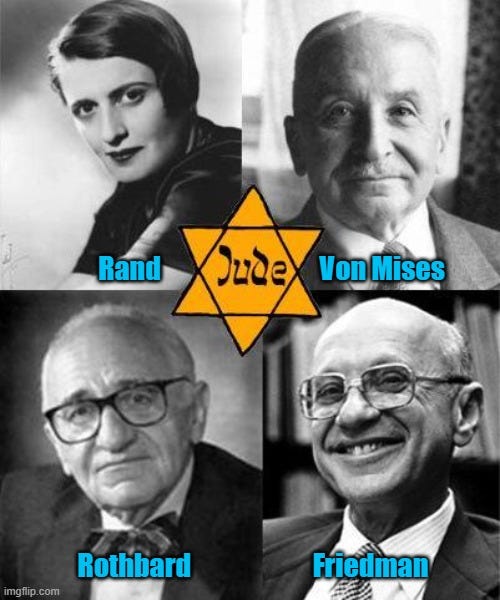
The last point regarding the linkage between neoliberals and neoconservatives is also a flawed narrative - that is an ethnic connection going back to the 1960s and Strauss, Wohlstetter and Milton Friedman at the Univ of Chicago. Just as he’s saying neoconservative has had its meaning blurred - which he does from the beginning himself by not focusing solely on foreign policy - he appears to be using the commonly-blurred meaning of neoliberalism today. Just for the record, the start of the wiki on neoliberalism:
Neoliberalism is a term used to signify the late-20th century political reappearance of 19th-century ideas associated with free-market capitalism after it fell into decline following the Second World War. A prominent factor in the rise of conservative and right-libertarian organizations, political parties, and think tanks, and predominantly advocated by them, it is generally associated with policies of economic liberalization, including privatization, deregulation, globalization, free trade, monetarism, austerity, and reductions in government spending in order to increase the role of the private sector in the economy and society.
Back to Unz:
Our nation’s two most recent Secretaries of State have been Mike Pompeo and Antony Blinken, and I’m not whether either of them even considers himself a Neocon, given that their foreign policy views are almost universal within their political circle. Do fish think that water is wet?
So this is a claim that the goy from Wichita and the Jew from New York have the same gut-level feelings toward Russia? Intellectually they may run in parallel, maybe even viscerally, but does that get down into both their DNA? If you asked them what their one-word first reaction is to the word “Russia”, I’d guess for Pompeo it would be “commies” and for Blinken “pogroms”; one is more philosophical and political (and historical) and the other is more personal and existential (and omnipresent).
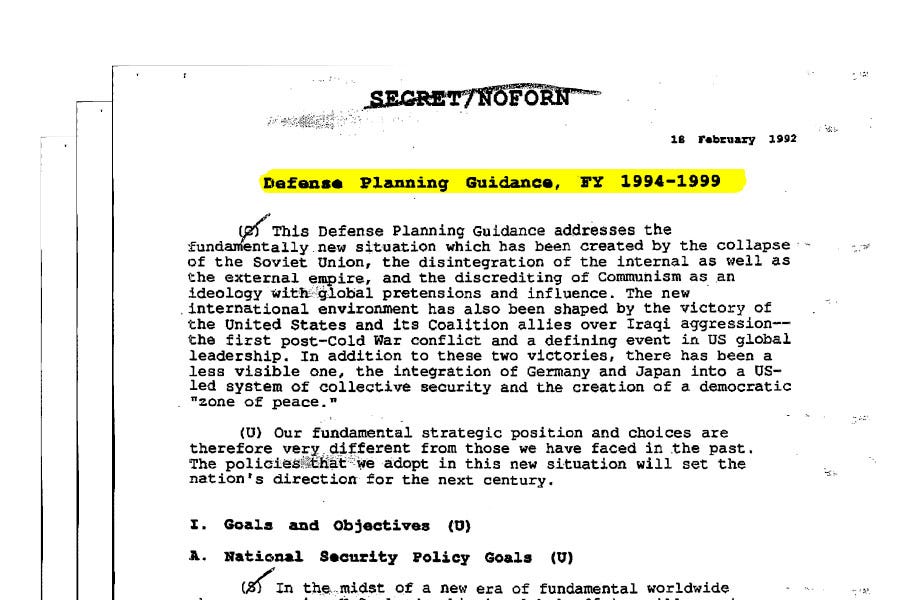
But consider the reality of today’s American foreign policy. In 1992 Neocon Paul Wolfowitz had drafted a Defense document advocating measures to ensure our permanent global military dominance but when it leaked the proposal was immediately repudiated by our Republican President and top military leaders, let alone the Democrats; however a decade later this “Wolfowitz Doctrine” had became our policy under Bush and today it enjoys complete bipartisan support.
So finally Unz is getting at the vital importance of Wolfowitz, and why his naming as Deputy Sec of Defense should have be so concerning. And one can make a case that the Wolfowitz Doctrine on preemptive military action was based on the philosophy of Leo Strauss; in fact MacDonald makes that basic claim elsewhere in the interview above. Here again is Jones in TJRS:
All that was in the future during the mid-’90s, when the drumbeat for America’s entry into World War IV began. [World War III to the neocons was the defeat of communism, which I guess means the defeat of Putinism is their World War V] In 1997 Paul Wolfowitz, a Straussian from the University of Chicago, called for the overthrow of Saddam Hussein in the Weekly Standard. Wolfowitz, whose parents had moved from Warsaw to New York, became Undersecretary of Defense during the second Bush administration; he used that position to lobby for war against Iraq. Four days after the attack on the World Trade Center, Wolfowitz met with President Bush and urged him to attack Iraq before invading Afghanistan, even though there was no evidence Saddam was involved in 9/11, and there was evidence that Osama bin Laden was hiding in Afghanistan. President Bush rejected Wolfowitz’ advice, but he put the invasion of Iraq in motion, asking his military advisors to develop plans.
Back to Unz:
Or consider the 28 standing ovations received by the Israeli prime minister when he spoke before a joint session of Congress in 2015, including the Stalinesque touch that some of our elected officials were denounced for applauding with insufficient enthusiasm. Given such a political environment, the strong pressure once exerted upon the Jewish State by such varied American Presidents as Carter, Reagan, Bush, and Clinton would be unthinkable today.
What’s unstated here is the role of American Jews in this, from AIPAC and the Jewish-Israel lobby to the big Jewish donors who hold these politicians’ fates in their hands - Bibi doesn’t hold the power, he just benefits from it. And that last claim about “strong pressure once exerted” is kinda laughable, especially regarding Reagan and Clinton. But he’s absolutely right about a material change in the general ability to criticize Israel over the last 40-50 years - which is a milder reflection on the change in ability to criticize Jews, today that simply being not at all. And so again we’re back to Holocaustism piled on top of political correctness.
Then Unz continues to wander off the path again regarding Israel:
However, one ironic aspect of the complete Neocon capture of the American foreign policy establishment is that its key figures have become far less easily swayed by the Israeli government on some other matters than they might have been a couple of decades ago.
When the Neocons were merely a political faction, they were naturally influenced by the leadership of an important world government that controlled powerful assets within the American system. But the newer generation of leaders have grown up at the helm of the world’s sole global superpower and except for Middle Eastern issues probably pay much less deference to the positions of Tel Aviv than in the past.
“Except for Middle Eastern issues”? Where else has the US government ever kowtowed to Israel? Sure, there’s economic/trade stuff, legal/extradition matters, etc., but I don’t know that the approach to these kind of things have changed or if they’re of real interest to neocons as neocons. I have no idea what he’s trying to claim here, at least I didn’t until he applied this to Ukraine next. I mean, does Israel have some important position on, say, North Korea, that the US government is simply ignoring and wouldn’t have a few decades ago?
Consider, for example, the Ukraine war, provoked by the Neocon-driven expansion of NATO and immediately followed by an unprecedented political and economic attack against Russian President Vladimir Putin and his country. Despite their ongoing conflict in Syria, Israel has generally maintained quite amicable relations with Russia over the last couple of decades, with the million or more Russian-Israelis constituting a powerful voting bloc and with several of Russia’s wealthiest oligarchs holding dual citizenship. For these reasons, Israel has been very reluctant to go along with the West’s anti-Russian sanctions or assist Ukraine, and unlike our European vassals, possesses sufficient political independence to maintain that position against American pressure.
The assumption here is that neocons have been driven by what instructions Israel has given them, which is a flawed way to think about the ethnic commonality and motivations involved. Ukraine/Russia involves another set of Ashkenazi ethnic motivations, even if political realities and interests in Israel don’t allow the Israelis to act on them in the same way. If suddenly Iran attacked Israel I am certain the US neocon reaction wouldn’t be, “sorry, but we’re just too busy in Ukraine right now - can you hold them off for a couple years… without using the nukes you don’t have?”
What’s more interesting to me is that he’s acknowledging that many of the “Russian” oligarchs are Jews, which gets to the ‘90s privatization story he didn’t mention, and that many of the more recent Russian immigrants to Israel may not even be Jewish, which is kind of an open secret I believe, they being allowed in to boost Bibi's base. And if not, does anyone believe Jews who fled Russia for Israel from the USSR and after its breakup still hold real allegiance to that supposedly-antisemitic state and it’s people?
Finally, Unz gets to what I think the point of this article really is:
Israeli leaders have been equally reluctant to join the Neocon-led campaign against China, which they regard as not in their own national interests.
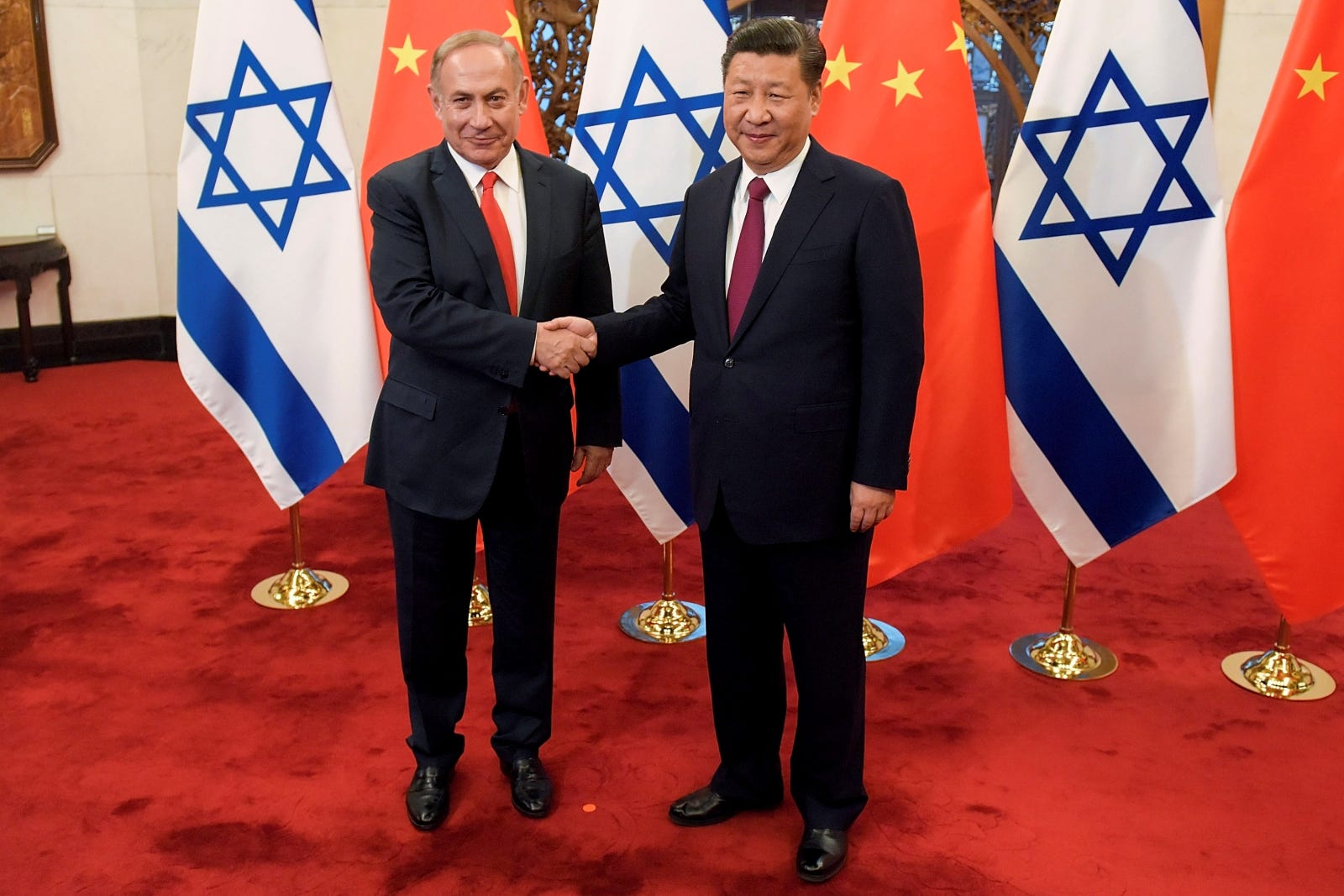
He published two other articles involving neoconservatism over the previous couple weeks, both focused on China. The second was largely a promotion of his work on his theory that covid was actually produced and released by the US bioweapons folks involving the neocon-infected “foreign policy establishment” as an attack on China and Iran, without Trump’s knowledge.
Under this explosive reconstruction, the Covid disease epidemic that has taken more than million American lives resulted from the blowback of a botched American biowarfare attack against China (and Iran), an attack carried out without the knowledge or approval of President Donald Trump.
Now, I have not gone back and looked at all his work on this, but based on what he said in that piece I don’t buy it, it seems very circumstantial to say the least. And any virus of this sort that could do real damage in those states would surely spread much farther, as it in fact did.
But he did make one comment in this that caught my eye, which was a quote of something he wrote three years ago:
Earlier this month, an ABC News story cited four separate government sources to reveal that as far back as late November, a special medical intelligence unit within our Defense Intelligence Agency had produced a report warning that an out-of-control disease epidemic was occurring in the Wuhan area of China, and widely distributed that document throughout the top ranks of our government, warning that steps should be taken to protect US forces based in Asia. After the story aired, a Pentagon spokesman officially denied the existence of that November report, while various other top level government and intelligence officials refused to comment. But a few days later, Israeli television mentioned that in November American intelligence had indeed shared such a report on the Wuhan disease outbreak with its NATO and Israeli allies, thus seeming to independently confirm the complete accuracy of the original ABC News story and its several government sources.
It therefore appears that elements of the Defense Intelligence Agency were aware of the deadly viral outbreak in Wuhan more than a month before any officials in the Chinese government itself. Unless our intelligence agencies have pioneered the technology of precognition, I think this may have happened for the same reason that arsonists have the earliest knowledge of future fires.
This kind of suggests to me that if the intentional release narrative has any validity, perhaps that was done by Israel, which dovetails with the one piece of effectiveness evidence provided by Unz:
Let us consider the implications of these facts. Across the entire world the only political elites that have yet suffered any significant human losses have been those of Iran, and they died at a very early stage, before significant outbreaks had even occurred almost anywhere else in the world outside China. Thus, we have America assassinating Iran’s top military commander on Jan. 2nd and then just a few weeks later large portions of the Iranian ruling elites became infected by a mysterious and deadly new virus, with many of them soon dying as a consequence. Could any rational individual possibly regard this as a mere coincidence?
Uh, yes. It’s also worth remembering that Israel had its deal with Pfizer’s CEO Jew Bourla for preferencial treatment regarding the vaccine, and was the first country to get mass vaccinated. Israel claims only about 12,500 deaths from covid, which is about a third of the US death rate.
Of course Pompeo the non-Jewish non-neocon neocon is the Dick Cheney in this China story - this from the main neocon article:
For example, Secretary of State Mike Pompeo probably ranks as the most prominent Deep State Neocon in the Trump Administration, and is a leading architect of our confrontation with China. Last week he broke quarantine to take a trip to Israel and hold important talks with Prime Minister Benjamin Netanyahu, as reported in a 1,600 word NYT article. Although the majority of their discussion concerned American support for the proposed annexation of the Palestinian West Bank, a serious disagreement arose concerning Israel’s growing economic ties with China, with the piece noting that the Jewish State had “antagonized” Washington by allowing Chinese companies to make major infrastructure investments, some of them in sensitive locations. According to the three Times journalists, Netanyahu firmly stood his ground, determined to “push back” against Pompeo’s repeated warnings and refused to reconsider his government’s China policy.
But just a couple of days later, the Times then reported that Du Wei, the Chinese ambassador to Israel, age 57, had been found dead at his home, having suddenly fallen victim to “unspecified health problems.” The piece emphasized that he had become a leading public critic of America’s current policies toward China, and the juxtaposition of these two consecutive NYT articles raised all sorts of obvious questions in my mind.
You can tell where this is going:
Pompeo had recently served as CIA Director, and he may have called in a few favors with elements of the Israeli Mossad and had them take lethal steps to convince Netanyahu that our demands that he reassess his ties with China were of a serious nature, not to be treated lightly. I strongly suspect that the controversial Chinese-Israeli economic ventures will soon be curtailed or abandoned.
So now the neocon has become a goy phenomenon, and it’s the Jewish state that’s getting pushed around! Unbelievable, shades of Gnome Chomsky. But this gets us back to the possibility of a deeper Israeli role in some of these events.
Me, I think the China thing, which is a clear and present danger to the US global economic hegemony, is being used as misdirection these days. I started to see that a few years ago when people like the Grayzone Jews started pumping the idea of a new cold war against the new axis of Russia and China (and Iran, of course). It’s a convenient way to cover up the ethnic motivations behind the war on hated mother Russia - and the Israeli-sourced war on their greatest threat Iran.
My prediction has been and remains that we will never (well, not in the foreseeable future anyway) see actual military conflict with China. It just makes no sense, given all the economic connections between the two countries and the damage that could be inflicted on the US economically. And unlike Russia and Iran, there is no irrational ethnic hatred involved, no DNA-based existentialism at play.
On the other hand, I haven’t spent much time looking at the complicated China matter, so I probably shouldn’t be making bold predictions when the Jews are so at play in the situation…
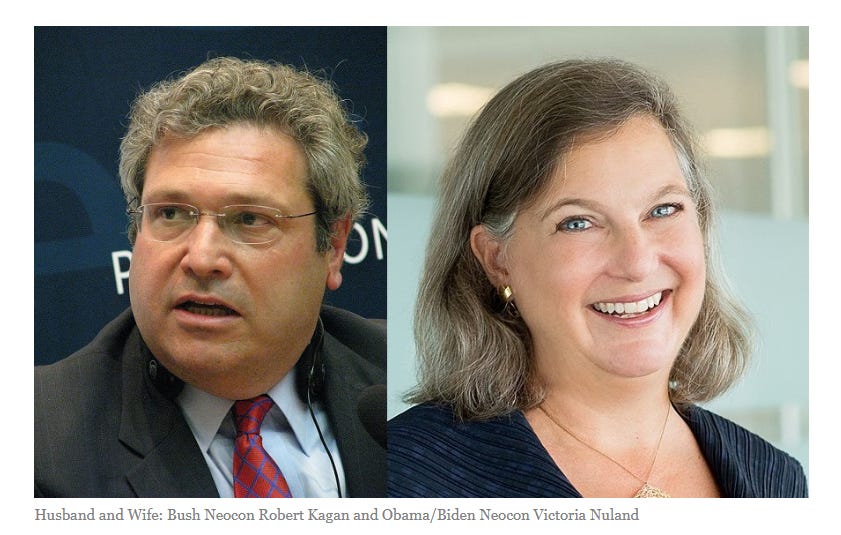
But back to Unz and his history lesson, let’s look at this from the standpoint of the most important neocon Jews. Sachs listed ten in his article which I addresses in my first piece here on substack last September - Leo Strauss, Donald Kagan, Norman Podhoretz, Irving Kristol, Paul Wolfowitz, Robert Kagan, Frederick Kagan, Victoria Nuland, Elliott Abrams and Kimberley Allen Kagan. Five of them are from the Kagan clan. I added eight more neocon Jews to the list in the piece - Bill Kristol, Richard Perle, Douglas Feith, Albert Wohlstetter, John Podhoretz, Midge Decter, Richard Pipes and Daniel Pipes. I could have and perhaps should have added more, like Scooter Libby, David Wurmser, Dov Zakheim, Michael Ludeen. Part of my logic was to underline the first families of neoconservatism - Sachs’ Kagans, the Kristols, Podhoretzes, Pipeses - to show how tight this cabal has really been.
Phil Giraldi is a valuable voice who has long published at Unz.com, including his article titled America's Jews Are Driving America's Wars in 2017, which got him fired from the American Conservative. In that article he also names Bill Kristol, Michael Ludeen, Daniel Pipes, John Podhoretz, Elliot Abrams, Kimberly Kagan, Frederick Kagan, David Wurmser, Paul Wolfowitz, Douglas Feith, Scooter Libby, Philip Zelikow among many others (his was a contemporary list, it doesn’t go back to the beginning and the “elder neocons”).
So who from this list of 18 by Sachs and I gets named by Unz? Robert Kagan once in a photo caption, Victoria Nuland three times, Norman Podhoretz twice, Irving Kristol twice, Bill Kristol once, Wolfowitz four times, Feith once, and that leaves 11 of the 18 unmentioned, including Strauss, Wohlstetter and Perle. But Pompeo gets mentioned nine times, more than twice as much as anyone else here.
So is this a good history of neoconservatism? Not particularly, in my opinion, although it’s certainly useful. I at least mildly disagree about a significant portion of the narrative, but the biggest failing in my view is right at the beginning, mainly the failure to even mention the Univ of Chicago intellectual roots of neoconservatism. The second most-obvious problem is the line of BS on the grim neocon situation vis-a-vis a new Bush administration in 2000. The third is probably the flip to goy neocons under Trump.
Unz talks about Jews much more than any mainstream source ever would, but he also engages in ethnic-blurring, which starts with his initial framing of who the term neoconservative applied to in the 1970s instead of addressing the roots of what would become neoconservatism in the ‘80s and beyond, and comes to a head at the end with Pompeo. And I struggle to really identify any part of this that I think is particularly good, although the material on the 1992 election and his own interactions with the neocons in the ‘90s are interesting (and with regard to the latter, I fear quite incomplete).
Why is Unz doing what he’s doing here? Obviously it’s all tied to his view on the handling of China by the Trump and Biden administrations, which is the other thread running through all three of these recent pieces on neoconservatism. But is he intentionally bending and avoiding material in this story for some specific purpose, including a subtle level of Jewrasure? I have no idea, it’s not clearly blatant in a mainstream sense and I don’t know his work well enough to even hazard an educated guess. But it may well be that he’s a little like Max Blumenthal, who always stops just short of the thin blue line; Ron steps over that line, but just barely, he won’t plant both feet firmly on the other side. In this case one could say he has one foot in the real story of neoconservatism and one in the wikipedia version.
I’ll end this by getting back to the question I posed last week, about what Unz might think of Sachs’ sudden shapeshifting from neocons to the MIC. Given his demonization of MIC-product Pompeo as the new Dick Cheney here, perhaps he wouldn’t mind too much.
Lastly, another important thing that is largely missing in this story is the context of neoconservatism over the last 50-60 years, the overall rise of Jewish power and influence, and the philosophies pushed as part of that. Unz vaguely approaches that almost by accident a few times, when he mentions the domestic social side of the neocon worldview and then the neoliberals near the end, and he generalizes about Israeli power, but doesn’t come remotely close to painting any kind of complete picture. And, as I said much earlier, the Holocaust is never mentioned, an event which has absolutely defined Ashkenazi Jewry and so much of its politics and activism over the last 75 years. There simply isn’t a hint of a unifying theory here.
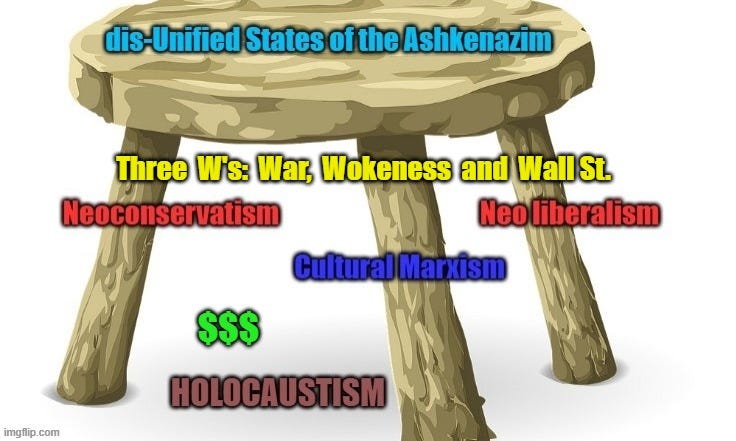
So this gets me back to where I started with RFK Jr., the one image which kinda explains it all:
Here is a link to Unz’ article: The Neocons and Their Rise to Power, by Ron Unz - The Unz Review
https://twitter.com/bfcarlson/status/1601216811483250688